
When shopping for work gloves, most people focus on the obvious things: how they fit, how much they cost, and whether they look tough enough to handle the job.
But one of the most important parts of a dipped work glove is something you might not think twice about.
The coating on the palm.
Two of the most popular coatings you'll find on work gloves are nitrile and polyurethane (PU).
Both are used to improve grip and provide additional protection against surface wear, but they aren't exactly the same.
Depending on your job, the coating can influence how easily you handle tools, how comfortable your gloves feel, and how they perform during repeated material handling.
At Digits Workwear, we use both coating types in our dipped work glove lineup.
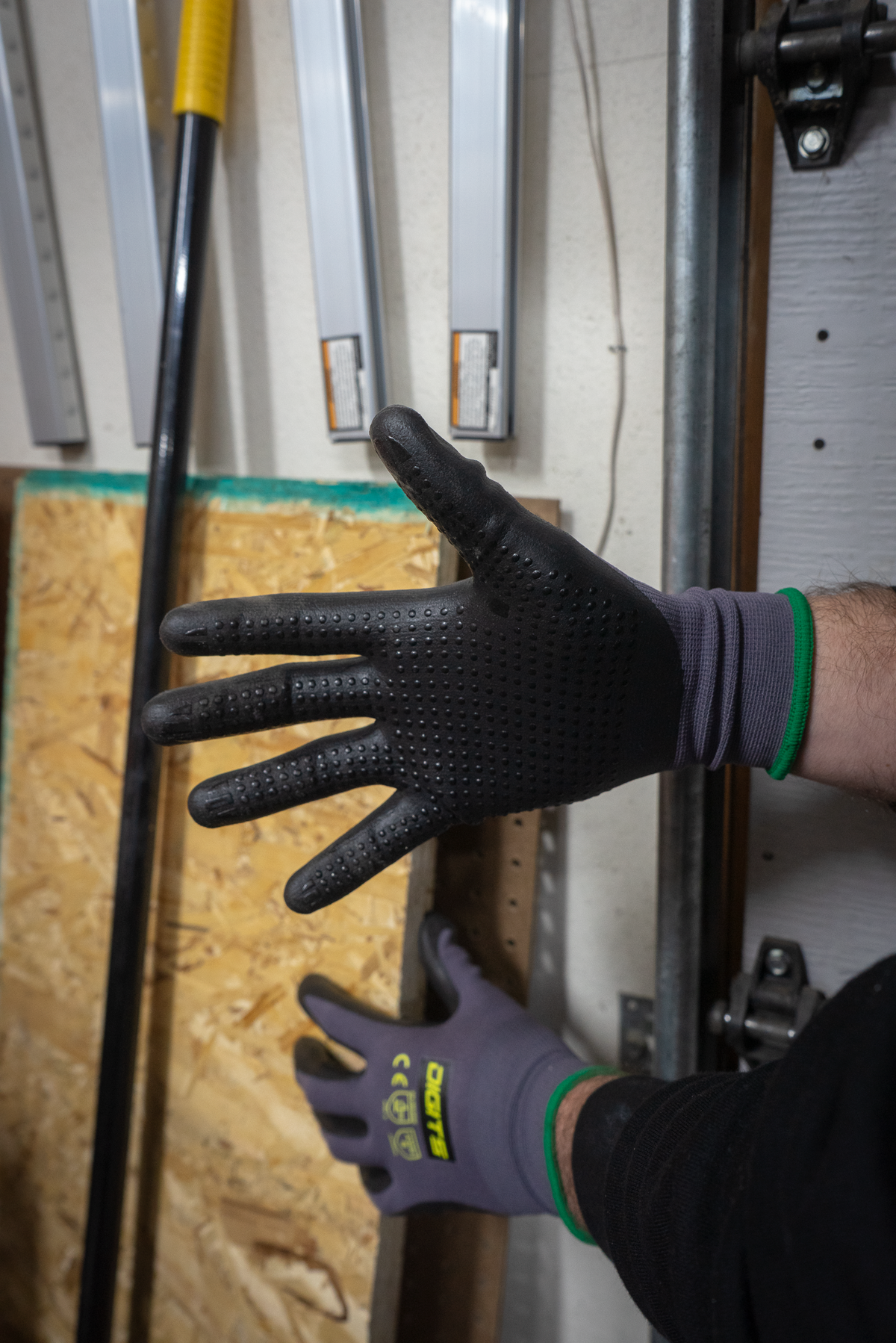
Our Liteduty PRO features a nitrile foam palm with anti-slip grip dots, while our Steelguard PRO uses a polyurethane-coated palm paired with an ANSI A5 cut-resistant liner.
So which one should you choose?
Let's get into the differences.
What's the Difference Between Nitrile and PU-Coated Work Gloves?
The primary difference between nitrile and polyurethane work glove coatings is how their materials and formulations affect grip, flexibility, and resistance to wear.
Nitrile-coated gloves are commonly selected for repetitive handling tasks that require abrasion resistance and dependable grip. Foam nitrile designs can provide useful traction in dry and certain lightly oily conditions.
PU-coated gloves are frequently used for precision-oriented work where flexibility and tactile control are important.
However, not every nitrile or PU glove performs the same way.
Different formulations, coating thicknesses, surface textures, and underlying glove liners can significantly influence performance.
A glove's coating is also only one part of its construction.
The knitted liner determines much of the glove's fit and contributes to protective properties such as cut resistance.
Understanding how these components work together is more useful than choosing gloves based on coating material alone.
What Are Nitrile-Coated Work Gloves?
Nitrile-coated work gloves use a synthetic rubber-based coating applied to portions of a fabric glove, usually the palm and fingers.
The fabric liner can be made from nylon, polyester, spandex, cut-resistant fibers, or other materials.
The coating improves contact with tools and materials while adding a protective layer against surface friction.
Nitrile is popular in industrial work gloves because it can be formulated to provide abrasion resistance, flexibility, and grip in different working conditions.
What Is Nitrile Foam?
Nitrile foam is a specialized type of nitrile coating.
Its structure is designed to balance flexibility, surface contact, and grip.
Depending on the formulation and texture, foam nitrile can perform well in dry and lightly oily conditions.
This is one reason it's used in gloves intended for maintenance, assembly, construction, and material handling.
Some nitrile foam gloves incorporate additional textured patterns or grip dots to further improve handling.
Benefits of Nitrile-Coated Gloves
Common advantages include:
-
Grip for handling tools and materials
-
Abrasion resistance during repetitive tasks
-
Flexible construction when paired with suitable liners
-
Coating options for different working conditions
-
Suitability for many general-purpose industrial applications
However, the exact performance depends on the specific glove.
An ordinary nitrile-coated glove should not be assumed to have high cut resistance simply because its palm is coated.
What Are PU-Coated Work Gloves?
Polyurethane, commonly shortened to PU, is another synthetic coating used on protective work gloves.
PU coatings are often selected for lightweight gloves where finger movement and tactile control are especially important.
A thin PU coating can provide a useful gripping surface without creating the bulky feel associated with some heavier glove designs.
This makes PU-coated gloves popular for precision tasks, assembly work, material handling, and applications where workers frequently manipulate smaller components.
Benefits of PU-Coated Gloves
Common advantages include:
-
Lightweight coating options
-
Good flexibility and tactile control
-
Grip for dry handling tasks
-
Compatibility with fine-gauge knitted liners
-
Reduced bulk in precision-oriented designs
PU coatings can vary in formulation, thickness, and texture.
These variations affect their performance in different conditions, including exposure to light oils.
The best choice depends on the actual glove and the materials being handled.
Nitrile vs. Polyurethane Work Gloves: Side-by-Side Comparison
Here's a simplified look at the general differences.
| Feature | Nitrile-coated gloves | PU-coated gloves |
|---|---|---|
| Primary strengths | Grip and resistance to surface wear | Flexibility and tactile control |
| Common applications | Maintenance, warehousing, material handling | Precision handling, assembly, detailed work |
| Dry grip | Can perform well | Can perform well |
| Light oil exposure | Certain foam and textured designs perform well | Performance varies by formulation |
| Abrasion resistance | Available in highly abrasion-resistant designs | Varies by coating and construction |
| Dexterity | Depends on liner and coating | Often selected for thin, flexible designs |
| Cut resistance | Depends on the tested glove materials | Depends on the tested glove materials |
| Waterproof protection | Not automatically waterproof | Not automatically waterproof |
This comparison describes common characteristics, not guaranteed performance for every product.
A specific glove's published ratings and construction provide more useful information than its coating material alone.
Which Coating Is Better for Grip?
Grip is one of the biggest reasons workers choose dipped gloves.
Whether you're carrying tools, handling materials, or tightening fasteners, having dependable traction can make everyday work easier.
Both nitrile and PU coatings can provide good grip, but the ideal choice depends on the surface.
Grip in Dry Conditions
Many nitrile and PU-coated gloves perform well when handling dry materials.
PU coatings are often appreciated in precision work because of their relatively thin, flexible feel.
Textured nitrile coatings can offer additional traction during repetitive handling.
Grip in Lightly Oily Conditions
Some nitrile foam formulations are designed to provide grip in lightly oily working conditions.
Surface texture and coating formulation can influence how well a glove maintains contact with an oily object.
However, the presence of nitrile alone doesn't establish a glove's performance in every oily environment.
Grip in Wet Conditions
Wet surfaces introduce different challenges.
Neither nitrile nor PU coatings should automatically be assumed to deliver reliable wet grip.
For consistently wet environments, look for gloves specifically designed and tested for those conditions.
The key takeaway is simple.
The best grip comes from choosing a glove designed for the actual material and working conditions, not just choosing a coating name.
Which Is More Durable: Nitrile or PU?
Durability is another important consideration.
Work gloves experience constant rubbing, friction, stretching, and contact with different surfaces.
Over time, this wears down the protective coating.
Nitrile coatings are often chosen for abrasion-resistant gloves, and some formulations perform especially well under repeated friction.
PU coatings can also provide useful abrasion resistance, but their performance depends on the design.
The most reliable way to compare durability is to look for tested abrasion ratings.
What Is ANSI Abrasion Resistance?
ANSI/ISEA 105 provides classifications for abrasion resistance.
Abrasion testing evaluates how well a material withstands repeated surface wear under controlled conditions.
These classifications help buyers compare gloves intended for demanding tasks.
For workers concerned about friction and repeated handling, an abrasion rating can be particularly useful.
Why We Gave Liteduty PRO a Nitrile Foam Palm
Our Liteduty PRO is designed for workers who spend their days gripping tools, moving materials, and performing repetitive tasks.
It features a nitrile foam coating with anti-slip grip dots.
More importantly, the glove carries an ANSI Level 6 abrasion rating, the highest abrasion classification on the ANSI scale.
It also carries an EN 388 Level 4 abrasion rating, the highest level for abrasion within that European test category.
These tested ratings provide a clearer picture of its resistance to surface wear than simply saying the glove is durable.
For workers who prioritize abrasion resistance and grip, Liteduty PRO is a practical option to consider.
Shop Liteduty PRO Nitrile-Coated Work Gloves
Is Nitrile or PU Better for Dexterity?
Dexterity refers to the ability to move your fingers and manipulate objects while wearing gloves.
For workers handling small screws, tools, brackets, and mechanical components, dexterity can make a significant difference.
The coating affects flexibility, but the liner is equally important.
A thin coating paired with a fine-gauge knitted liner can provide a close fit and improved tactile control.
However, gauge alone doesn't determine dexterity.
The underlying fibers, stretch, coating thickness, and fit all influence how a glove moves with your hand.
Understanding Glove Gauge
Glove gauge describes the knitting density used to construct the liner.
Higher-gauge knitted liners generally use finer yarns and can create thinner designs, depending on the construction.
For example:
15-gauge liners: Often used in lightweight work gloves that balance flexibility, comfort, and durability.
18-gauge liners: Frequently used in precision-oriented gloves designed for a thinner, closer feel.
Neither gauge is automatically superior.
The finished glove should be evaluated based on the work being performed.
Meet the Liteduty PRO: Nitrile-Coated Gloves Built for Everyday Work

At Digits Workwear, we designed Liteduty PRO for workers who need grip, durability, and comfort during repeated daily use.
Not every job requires a specialized cut-resistant glove.
Sometimes you simply need something comfortable that can handle constant wear without getting in the way.
That's the purpose of Liteduty PRO.
15-Gauge Nylon and Spandex Liner
Liteduty PRO uses a breathable 15-gauge liner made with nylon and spandex.
The combination is designed to provide flexibility and a close fit while allowing natural hand movement.
Nitrile Foam Coating
Its nitrile foam palm is designed for grip in dry and lightly oily conditions.
Anti-Slip Grip Dots
Additional grip dots provide texture for improved control when handling tools and materials.
ANSI Level 6 Abrasion Resistance
Liteduty PRO carries ANSI Level 6 abrasion resistance, the highest classification in that ANSI abrasion category.
EN 388 Level 4 Abrasion Performance
The glove also carries an EN 388 Level 4 abrasion rating.
Breathable Knit Back
An uncoated knitted back helps improve airflow while keeping the glove lightweight and flexible.
What Jobs Is Liteduty PRO Best For?
Liteduty PRO is designed for a variety of tasks, including:
-
Warehouse and material handling
-
General construction
-
Automotive maintenance
-
Landscaping and property maintenance
-
Equipment handling
-
DIY and home improvement
-
Light industrial work
For tasks where abrasion resistance, grip, and comfort are the primary concerns, Liteduty PRO provides a useful combination of features.
Shop Liteduty PRO High-Dexterity Work Gloves
Meet the Steelguard PRO: PU-Coated Gloves With ANSI A5 Cut Resistance
Our Steelguard PRO serves a different purpose.
Rather than focusing primarily on routine material handling, Steelguard PRO is designed for tasks involving sharp materials and the need for precision.
It uses a polyurethane-coated palm paired with an ANSI A5 cut-resistant liner.
18-Gauge HPPE and Steel Fiber Liner
Steelguard PRO combines HPPE and steel fiber in an ultra-thin knitted construction.
These materials contribute to the glove's ANSI A5 cut-resistance performance.
Polyurethane-Coated Palm
The PU-coated palm is designed to provide grip and abrasion resistance while maintaining flexibility.
Reinforced Thumb Area
Additional reinforcement between the thumb and index finger helps address wear in one of the most frequently stressed areas of a glove.
Touchscreen-Compatible Fingertips
Touchscreen compatibility allows users to operate compatible mobile devices without removing their gloves.
What Jobs Is Steelguard PRO Best For?
Steelguard PRO is designed for consideration in tasks involving sharp materials, including:
-
Sheet-metal handling
-
Metal fabrication
-
HVAC installation
-
Sharp-edged component handling
-
Certain automotive repairs
-
Industrial material handling involving cut hazards
Because its primary protective classification is ANSI A5 cut resistance, Steelguard PRO is particularly relevant when sharp materials are a significant part of the job.
Shop Steelguard PRO ANSI A5 Cut Resistant Gloves
Steelguard PRO vs. Liteduty PRO: Which Should You Buy?
Although both gloves feature coated palms, they're designed around different priorities.
| Feature | Steelguard PRO | Liteduty PRO |
|---|---|---|
| Coating | Polyurethane (PU) | Nitrile foam with grip dots |
| Liner | 18-gauge HPPE and steel fiber | 15-gauge nylon and spandex |
| Main tested protection | ANSI A5 cut resistance | ANSI Level 6 abrasion resistance |
| Additional listed rating | Not specified | EN 388 Level 4 abrasion |
| Primary focus | Cut protection and precision handling | Everyday grip and abrasion resistance |
| Thumb reinforcement | Yes | No |
| Touchscreen compatibility | Yes | Yes |
| Best suited for | Sharp-material handling | Repetitive general-purpose work |
The choice comes down to the tasks you're performing.
Choose Steelguard PRO when you're working around sharp edges and need ANSI A5 cut resistance.
Choose Liteduty PRO when you're handling tools and materials throughout the day and want tested high-level abrasion resistance with a flexible nitrile-coated palm.
It's worth emphasizing that these two products' published ratings measure different things.
An ANSI A5 cut rating cannot be directly compared with an ANSI Level 6 abrasion rating.
Neither number, by itself, establishes which glove is better for every job.
Are Nitrile-Coated Gloves the Same as Disposable Nitrile Gloves?
No. This is an important distinction.
Disposable nitrile gloves and nitrile-coated work gloves are designed for different purposes.
Disposable nitrile gloves are thin, fully formed nitrile gloves commonly used for hygiene, contamination control, and certain chemical-handling applications when appropriately rated.
Nitrile-coated work gloves feature a fabric liner with a nitrile coating applied to selected areas.
They are typically designed for grip, mechanical handling, and repeated use.
Liteduty PRO is a reusable nitrile-coated work glove, not a disposable chemical-protection glove.
Are PU or Nitrile-Coated Gloves Waterproof?
Not necessarily.
Many dipped work gloves feature an uncoated, breathable fabric back.
Although the palm coating can provide some resistance to liquid contact, the glove as a whole isn't automatically waterproof.
Both Steelguard PRO and Liteduty PRO use breathable knitted construction.
They should not be treated as fully waterproof gloves or chemical-resistant barriers.
For tasks involving hazardous liquids, select gloves specifically tested and rated for the substances and exposure conditions involved.
Frequently Asked Questions About Nitrile and PU Work Gloves
Is nitrile better than polyurethane for work gloves?
Neither coating is universally better. Nitrile coatings are commonly used for abrasion-resistant material handling, while PU coatings are often chosen for precision-oriented work. The right option depends on the specific glove, the materials being handled, and the job's hazards.
Which coating is better for oily conditions?
Certain foam nitrile coatings are designed to provide grip in lightly oily conditions. However, the actual performance depends on formulation and texture. Gloves should be selected based on their suitability for the specific working environment.
Are nitrile-coated gloves cut-resistant?
Not automatically. A nitrile coating doesn't establish a glove's cut-resistance rating. Cut protection depends on the glove's construction and tested performance.
Are PU-coated gloves good for metal fabrication?
They can be, particularly when paired with a suitably cut-resistant liner. Steelguard PRO combines a PU-coated palm with ANSI A5 cut resistance, making it an option to evaluate for certain metal-fabrication handling tasks.
Which glove is better for warehouse work?
For general warehouse tasks that prioritize grip, repeated handling, and abrasion resistance, Liteduty PRO is a practical choice. If the work involves significant cut hazards, a glove with an appropriate cut-resistance rating may be needed.
Are nitrile-coated gloves good for mechanics?
They can be useful for tasks requiring grip and flexibility, particularly in dry and lightly oily conditions. However, mechanical work involving sharp edges, rotating equipment, chemicals, or high temperatures may require a different glove or additional precautions.
What's the difference between a 15-gauge and an 18-gauge glove?
Gauge describes the knitting density of a glove liner. An 18-gauge liner generally uses finer yarns than a 15-gauge liner, but the glove's overall thickness, dexterity, and protection also depend on the fibers and coating used.
Can nitrile and PU-coated work gloves be washed?
Some can be washed according to the manufacturer's directions. Digits Workwear recommends hand washing Steelguard PRO and Liteduty PRO in cold water, avoiding bleach, and hanging them to dry. Always inspect gloves for damage before reuse.
The Right Coating Makes a Difference
When it comes to work gloves, the details matter.
The material on your palm, the construction of the liner, the grip texture, and the glove's tested performance all contribute to how it works throughout the day.
Nitrile and polyurethane both have their advantages.
Nitrile foam can be a great choice for repetitive handling, grip, and abrasion-resistant applications.
PU coatings can be an excellent option when flexibility and precision handling are priorities.
But the most important consideration is how those coatings work with the rest of the glove.
At Digits Workwear, we've taken two different approaches to help workers find the right fit for their jobs.
Liteduty PRO combines nitrile foam grip with ANSI Level 6 abrasion resistance for everyday work.
Steelguard PRO combines a flexible PU-coated palm with ANSI A5 cut resistance for tasks involving sharp materials.
Different gloves. Different jobs. The same commitment to keeping hardworking hands protected.
PROTECT YOUR DIGITS.
Shop Liteduty PRO Nitrile-Coated Work Gloves
Best Work Gloves for Metal Fabrication and Sheet Metal: What to Look For