
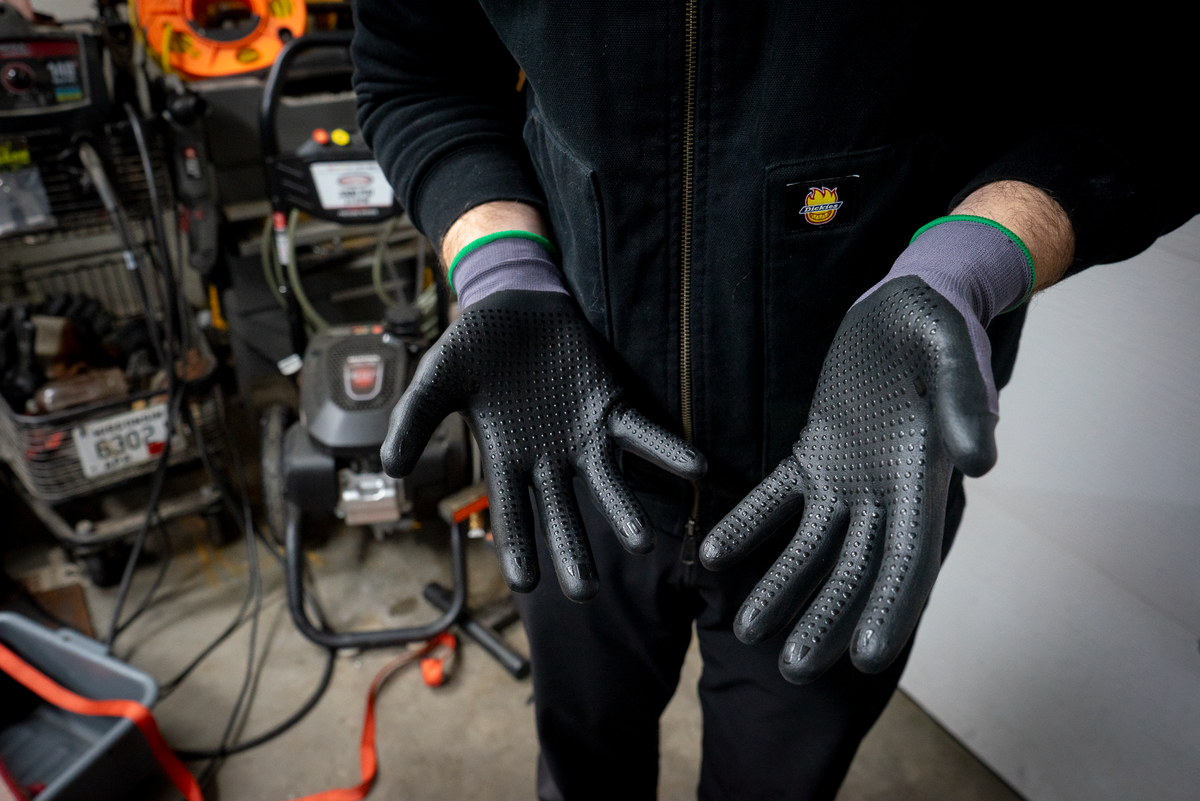
Not all work gloves are built the same. Whether you're handling sharp sheet metal, working on a construction site, turning wrenches in the garage, or moving materials all day, the right pair of gloves can make a serious difference in your comfort, grip, and protection.
That's where dipped work gloves come in.
Dipped work gloves combine a flexible fabric liner with a protective coating on the palm and fingers. The result is a work glove designed to provide grip, flexibility, and protection without the bulk of traditional work gloves.
At Digits Workwear, we've developed two dipped work gloves for different demands: the Steelguard PRO and the Liteduty PRO.
The Steelguard PRO is an ANSI A5 cut-resistant glove designed for jobs involving sharp materials. The Liteduty PRO is a high-dexterity, abrasion-resistant glove designed for repeated handling, tool use, and everyday work.
Both are built around a simple idea: your gloves should protect your hands without getting in the way of the work you're trying to accomplish.
In this guide, we'll break down how dipped work gloves work, what makes different coatings and materials important, and how to choose the right glove for your job.
What Are Dipped Work Gloves?
Dipped work gloves are protective gloves made with a knitted fabric liner and a coating, such as nitrile, polyurethane (PU), or latex, applied to the palm and fingers to improve grip and resistance to wear.
Unlike bulky leather gloves or fully coated rubber gloves, many dipped gloves leave the back of the hand uncoated. This allows for greater flexibility and airflow while providing additional protection in the areas that experience the most contact with tools and materials.
Dipped gloves have become a popular choice for construction workers, mechanics, warehouse employees, fabricators, landscapers, and DIY enthusiasts because they offer a practical combination of comfort and control.
The benefits of a well-designed dipped glove include:
-
Improved grip: Coated palms help workers maintain control of tools, equipment, and materials.
-
Greater dexterity: Flexible materials allow fingers to move naturally when handling smaller objects.
-
Breathability: Knitted liners and uncoated backs help improve airflow.
-
Abrasion resistance: Durable coatings help protect against the friction and wear associated with repeated material handling.
-
Task-specific protection: Certain dipped gloves incorporate specialized fibers to provide additional cut resistance.
-
Comfort: Lightweight construction can be more comfortable than heavier gloves during extended wear.
However, not every dipped glove provides the same protection. The materials, coating, construction, and tested safety ratings determine which jobs a glove is suitable for.
Understanding those differences is the key to choosing the right pair.
Steelguard PRO vs. Liteduty PRO: What's the Difference?
The biggest difference between the Steelguard PRO and Liteduty PRO is the type of protection each glove is designed to provide.
Steelguard PRO prioritizes cut resistance and precision, while Liteduty PRO prioritizes abrasion resistance, flexible grip, and everyday comfort.
Here's how they compare.
| Feature | Steelguard PRO | Liteduty PRO |
|---|---|---|
| Primary purpose | Cut resistance and precision handling | Everyday grip and abrasion resistance |
| ANSI rating | A5 cut resistance | Level 6 abrasion resistance |
| Additional rating | Not specified | EN 388 Level 4 abrasion |
| Liner | 18-gauge seamless knit | 15-gauge nylon and spandex |
| Protective materials | HPPE and steel fiber | Flexible nylon and spandex |
| Palm coating | Polyurethane (PU) | Nitrile foam with anti-slip grip dots |
| Thumb reinforcement | Yes | No |
| Touchscreen compatible | Yes | Yes |
| Best suited for | Fabrication, sheet metal, sharp materials | Warehousing, mechanics, maintenance, general construction |
| Available sizes | S through XXL | S through XXL |
| Pack sizes | 3-pack and 10-pack | 3-pack and 10-pack |
It's important to understand that these gloves have different documented performance ratings. An ANSI A5 cut rating and an ANSI Level 6 abrasion rating measure different properties and cannot be directly compared.
Shop Steelguard PRO Cut Resistant Gloves
Shop Liteduty PRO High-Dexterity Gloves
Steelguard PRO: Cut-Resistant Work Gloves Built for Precision

If your work involves sharp edges, exposed metal, or materials that could cut through ordinary work gloves, cut resistance should be one of your top priorities.
The Digits Workwear Steelguard PRO is an ANSI A5 cut-resistant dipped work glove designed to provide substantial cut protection while maintaining the flexibility needed for detailed work.
At the center of the Steelguard PRO is an ultra-thin, 18-gauge seamless knitted liner constructed with high-performance polyethylene (HPPE) and steel fiber.
These materials provide the glove's cut-resistant properties while allowing it to remain lightweight and form-fitting.
What Does ANSI A5 Cut Resistance Mean?
ANSI A5 is a cut-resistance classification indicating that glove material withstands a cutting force of at least 2,200 grams but less than 3,000 grams under standardized laboratory testing.
ANSI/ISEA cut-resistance ratings range from A1 through A9, with higher ratings indicating greater resistance to cuts under the specified test conditions.
An A5 rating places the Steelguard PRO in a category suitable for consideration when handling materials with meaningful cut hazards, including sheet metal, metal components, and other sharp-edged materials.
The rating doesn't mean the glove is cut-proof. No cut-resistant glove eliminates every risk of injury, and protection can vary depending on the sharpness, angle, force, and nature of the hazard.
However, knowing a glove's tested cut rating gives workers and safety managers a more objective way to evaluate whether the glove is appropriate for their work.
An 18-Gauge Liner for High Dexterity
One of the most important features of the Steelguard PRO is its 18-gauge seamless knitted liner.
Glove gauge refers to knitting density. Higher-gauge liners generally use finer yarns and can create a thinner, more form-fitting feel, although the finished glove's flexibility also depends on the fiber blend, coating, and construction.
For workers who need to handle small fasteners, position metal components, or manipulate tools, this matters.
A glove that provides protection but limits your ability to grip and control materials can make ordinary tasks unnecessarily difficult.
The Steelguard PRO is engineered to reduce that compromise by combining cut-resistant fibers with a slim, flexible design.
PU-Coated Palms for Grip and Control
Steelguard PRO features a black polyurethane-coated palm designed to provide grip and abrasion resistance while retaining flexibility.
Polyurethane, commonly referred to as PU, is a popular coating for precision-oriented work gloves because it can be applied in a relatively thin layer.
For Steelguard PRO, this coating helps workers maintain control when handling tools and materials without adding unnecessary bulk.
This makes the glove a practical option for tasks requiring both protection and a more precise feel.
Reinforcement Where Gloves Wear Out First
Some of the hardest wear on a work glove occurs between the thumb and index finger.
Think about how often that area is involved when grabbing material, gripping a tool, carrying equipment, or pulling objects into position.
Over time, repeated contact and friction can wear through the coating and underlying fabric.
Steelguard PRO includes additional reinforcement between the thumb and index finger to help improve durability in this high-wear area.
Rather than focusing only on cut resistance, its design also addresses the repeated friction experienced during everyday work.
Touchscreen Compatible Work Gloves
Taking off your gloves every time you need to answer a call, look at a work order, or check a measurement on your phone gets old quickly.
Steelguard PRO includes touchscreen-compatible fingertips, allowing you to use compatible phones and tablets without constantly removing your gloves.
For contractors, fabricators, and other professionals who rely on their phones throughout the day, it's a practical feature that helps keep work moving.
What Jobs Are Steelguard PRO Gloves Best For?
Steelguard PRO is particularly well suited for work that combines sharp materials with the need for hand control.
Metal fabrication and sheet metal: Handling sheet metal, cut components, and sharp edges requires attention to cut hazards. The glove's A5 rating makes it an option to evaluate for this work.
Construction and demolition: When sharp metal strapping, exposed metal edges, or similar materials are present, additional cut resistance may be appropriate.
HVAC installation: Ductwork and sheet-metal components can have sharp edges. A flexible, cut-resistant glove can help workers handle these materials while maintaining control.
Automotive repair and maintenance: Working around sharp metal parts and components often requires a balance of dexterity and protection.
Glass and sharp-material handling: Tasks involving sharp glass edges call for appropriate cut protection, although separate assessment of impact, puncture, and other hazards is essential.
Warehouse and industrial work: Handling metal shelving, sharp strapping, or other potentially hazardous materials may call for a higher level of cut resistance than ordinary general-purpose gloves.
If your work regularly exposes your hands to sharp-edged materials, Steelguard PRO cut-resistant gloves are worth considering.
Liteduty PRO: High-Dexterity Dipped Gloves for Everyday Work

Not every job involves sharp metal or high cut hazards.
Sometimes, what you really need is a dependable pair of gloves that provides grip, comfort, and resistance to the repetitive wear associated with working all day.
That's where the Digits Workwear Liteduty PRO comes in.
Liteduty PRO is a lightweight, nitrile-coated work glove featuring a flexible 15-gauge nylon and spandex liner, nitrile foam palms, anti-slip grip dots, and ANSI Level 6 abrasion resistance.
It's designed for workers who spend their days handling materials, operating tools, making repairs, and completing tasks that demand constant hand movement.
What Does ANSI Level 6 Abrasion Resistance Mean?
ANSI Level 6 is the highest abrasion-resistance classification on the ANSI/ISEA 105 abrasion scale. It indicates that the glove material has met the testing requirements for the highest level of resistance to surface wear.
Abrasion is the gradual wearing away of material caused by repeated rubbing or friction.
For work gloves, abrasion can come from gripping rough lumber, moving boxes, handling equipment, carrying materials, or repeatedly using hand tools.
Over time, friction can weaken or wear through the coating and fabric of a glove.
Abrasion testing evaluates how well glove material holds up under controlled wear conditions.
Liteduty PRO carries two notable abrasion-performance classifications:
ANSI Level 6 abrasion resistance: The highest level of abrasion resistance under the ANSI/ISEA classification system.
EN 388 Level 4 abrasion resistance: The highest abrasion-resistance classification under the EN 388 European mechanical-risk standard.
Together, these ratings provide measurable evidence of the glove's resistance to surface wear.
It's important to note that abrasion resistance and cut resistance are different characteristics. A high abrasion rating does not automatically mean a glove offers high protection against sharp blades or metal edges.
Nitrile Foam Palms for a Secure Grip
A glove's coating can make a significant difference in the way it feels and performs.
Liteduty PRO uses a nitrile foam coating across the palm to improve grip in dry and lightly oily conditions.
Nitrile foam is a popular coating for work gloves because it combines flexibility with resistance to repeated surface wear.
This makes it useful for many types of general-purpose work where workers are continuously grabbing, lifting, or manipulating tools and materials.
Anti-Slip Grip Dots for Added Control
Liteduty PRO also incorporates anti-slip grip dots across the coated palm.
These dots are designed to provide additional traction when gripping tools and materials.
Whether you're carrying equipment, working with hand tools, or moving materials around a jobsite, maintaining a consistent grip can help make tasks easier to control.
The combination of a nitrile foam coating and textured grip dots is one of the features that separates Liteduty PRO from basic smooth-coated work gloves.
A Breathable 15-Gauge Nylon and Spandex Liner
Comfort matters when your hands are working for hours at a time.
Liteduty PRO uses a 15-gauge liner constructed from nylon and spandex.
The nylon provides the foundation of the glove's flexible fabric construction, while spandex contributes stretch and helps the glove conform to the hand.
The result is a lightweight design intended to move naturally with your fingers.
The breathable knitted back also helps improve airflow compared with a fully coated glove, making Liteduty PRO practical for extended use and warmer working conditions.
What Jobs Are Liteduty PRO Gloves Best For?
Liteduty PRO is designed for workers who prioritize everyday grip, dexterity, comfort, and abrasion resistance.
General construction: Handling tools, materials, and equipment during routine tasks where high cut resistance isn't required.
Warehouse work: Moving boxes, lifting products, handling pallets, and sorting inventory are tasks where grip and resistance to repeated friction can be valuable.
Automotive maintenance: Handling fasteners, tools, and components that require precision and a flexible feel.
Landscaping and property maintenance: Working with hand tools, equipment, and materials during outdoor maintenance projects.
Arborist and grounds work: Tasks involving tool handling, climbing-related equipment, and general cleanup may benefit from flexible, abrasion-resistant gloves, provided all applicable hazards and equipment requirements are assessed.
DIY and home improvement: Assembly, maintenance, garage projects, and routine household repairs where bulky gloves could make detailed tasks difficult.
Light industrial applications: Repetitive material handling and general tasks that demand consistent grip and flexibility.
For workers who need durable general-purpose gloves without unnecessary bulk, Liteduty PRO nitrile-coated work gloves provide a practical solution.
Cut Resistance vs. Abrasion Resistance: Why the Difference Matters

Two of the most important terms to understand when shopping for work gloves are cut resistance and abrasion resistance.
Although they sound similar, they measure different kinds of performance.
What Is Cut Resistance?
Cut resistance describes a material's ability to withstand contact with a sharp blade under standardized testing conditions.
This is especially relevant when working with sharp sheet metal, exposed edges, or materials that could slice through the glove.
Steelguard PRO is designed specifically for this category of protection, with its ANSI A5 cut rating and HPPE and steel fiber construction.
What Is Abrasion Resistance?
Abrasion resistance describes a material's ability to withstand repeated rubbing and friction before wearing through.
Consider someone carrying rough materials, gripping tools, or handling packages for an entire shift.
Even when sharp edges aren't the primary concern, constant contact can damage ordinary gloves.
Liteduty PRO addresses this type of wear with its nitrile foam palm and tested ANSI Level 6 abrasion resistance.
Which Rating Is More Important?
The answer depends on your work.
If you're handling sharp sheet metal, cut resistance may be a primary consideration.
If you're repeatedly handling packages or using hand tools where abrasion is the primary wear mechanism, abrasion resistance may be more relevant.
Neither rating replaces a proper assessment of other hazards, including punctures, impacts, chemicals, heat, or entanglement risks.
The most effective glove is the one selected for the actual hazards of the task.
PU vs. Nitrile-Coated Work Gloves: Which Is Better?
Polyurethane and nitrile are two common coatings used in dipped work gloves.
Both can improve grip, but their performance depends on the specific formulation, texture, and application.
Polyurethane (PU) Coatings
PU coatings are often selected for applications that demand precision and tactile control.
Because they can be applied in thin layers, PU-coated gloves can retain flexibility while providing an additional gripping surface.
The Steelguard PRO uses a PU-coated palm to complement its fine-gauge, cut-resistant knitted construction.
Nitrile Foam Coatings
Nitrile foam coatings are frequently used in general-purpose work gloves where comfort, abrasion resistance, and grip are priorities.
They can perform well in dry and certain lightly oily working conditions, depending on the glove's construction.
Liteduty PRO uses a nitrile foam coating with anti-slip grip dots to improve control while maintaining flexibility.
Which Should You Choose?
For jobs involving sharp materials and precision handling, the Steelguard PRO combines a PU palm with an A5-rated cut-resistant liner.
For routine handling, maintenance, and high-friction tasks without significant cut hazards, the Liteduty PRO combines a nitrile foam palm with high abrasion resistance.
Keep in mind that neither glove should be assumed to provide chemical protection or waterproof coverage simply because it has a coated palm.
Why Dexterity Matters in Work Gloves

Protection is essential, but it's only one part of what makes a work glove useful.
Dexterity is the ability to move and control your fingers while wearing gloves.
Workers rely on dexterity every day to position materials, use tools, pick up fasteners, and complete tasks that require precise movements.
When gloves are too bulky or stiff, even straightforward tasks can become frustrating.
This is one reason knitted dipped gloves are so popular.
By combining flexible liners with targeted protective coatings, they can offer a more natural feel than some heavier glove designs.
Both Steelguard PRO and Liteduty PRO prioritize flexibility, but they approach it differently.
Steelguard PRO pairs an 18-gauge HPPE and steel fiber liner with a PU coating for cut-resistant precision work.
Liteduty PRO pairs a stretchy 15-gauge nylon and spandex liner with nitrile foam for comfortable, everyday handling.
The ideal choice comes down to finding the right combination of hand movement, grip, and protection for your job.
How to Choose the Right Dipped Work Gloves for Your Job
Before purchasing work gloves, ask yourself a few important questions.
1. Am I Working With Sharp Materials?
If your daily tasks involve sharp metal edges, cutting hazards, or other materials that could slice through fabric, look for a glove with a documented cut-resistance rating.
Consider Steelguard PRO when ANSI A5 cut protection is appropriate for the identified hazards.
2. Will My Gloves Experience Constant Friction?
Repeated gripping, carrying, and material handling can cause glove coatings to wear down over time.
If abrasion is your primary concern, look for a glove with a tested abrasion-resistance rating.
Consider Liteduty PRO for its ANSI Level 6 abrasion resistance.
3. Do I Need to Handle Small Parts?
For detailed work, prioritize gloves that provide appropriate dexterity, fit, and grip.
Both Steelguard PRO and Liteduty PRO are designed to provide flexibility, although their materials and construction differ.
4. Will I Wear My Gloves for Extended Periods?
Breathability and comfort become increasingly important during long shifts.
Both gloves feature knitted construction and breathable backs.
Choose the glove that provides the necessary protection while fitting comfortably enough for your normal tasks.
5. What Conditions Will I Be Working In?
Consider whether you'll encounter dry, oily, wet, hot, or chemically hazardous environments.
Liteduty PRO's nitrile foam palm is designed for grip in dry and lightly oily conditions.
Steelguard PRO's PU palm is designed for precision grip and flexibility.
Neither product should be selected for chemical immersion, extreme heat, electrical exposure, or other specialized hazards without verified protection ratings for those applications.
How Long Do Dipped Work Gloves Last?
There isn't one universal answer to how long dipped work gloves last.
Glove life depends on the intensity of the work, materials being handled, fit, frequency of use, and maintenance.
Someone handling smooth cardboard boxes may experience very different wear compared with someone handling rough metal or abrasive building materials.
Instead of relying on a fixed replacement schedule alone, inspect your gloves regularly.
Look for worn-through coatings, exposed liner fibers, holes, loose seams, excessive stretching, or damage around the fingers and thumb.
For Steelguard PRO, inspect the cut-resistant liner and reinforced thumb area, especially after contact with sharp materials.
For Liteduty PRO, monitor the nitrile foam coating and grip dots for signs of heavy wear.
A glove should be replaced when damage affects its protective performance, even if it still appears usable for ordinary tasks.
How to Clean and Maintain Dipped Work Gloves
Proper care can help preserve comfort and extend the useful life of work gloves.
For both Steelguard PRO and Liteduty PRO, Digits Workwear recommends:
-
Hand wash in cold water. Gently remove ordinary dirt and grime without aggressively scrubbing the protective coating.
-
Avoid bleach. Harsh chemicals may damage the glove fibers or protective materials.
-
Hang dry. Allow gloves to air dry rather than exposing them to high heat.
-
Do not iron. High temperatures can damage synthetic fibers and coatings.
-
Inspect before reuse. Check for excessive wear or damage that could reduce protection.
If gloves become contaminated with hazardous chemicals or substances, follow the appropriate workplace safety procedures rather than assuming ordinary washing will make them safe to reuse.
Frequently Asked Questions About Dipped Work Gloves
What are the best dipped work gloves for construction?
The best dipped work gloves for construction depend on the hazards involved. For tasks involving sharp metal edges and cut hazards, ANSI A5-rated Steelguard PRO gloves may be appropriate. For general construction work that prioritizes grip, flexibility, and abrasion resistance, Liteduty PRO offers a lightweight nitrile-coated alternative.
Are Steelguard PRO gloves cut-resistant?
Yes. Steelguard PRO gloves have an ANSI A5 cut-resistance rating. They use an 18-gauge HPPE and steel fiber liner to provide cut resistance while maintaining flexibility. They are cut-resistant, not cut-proof, and should be selected based on the task's hazards.
Are Liteduty PRO gloves cut-resistant?
Liteduty PRO is marketed primarily as an abrasion-resistant, high-dexterity glove rather than a cut-resistant glove. Its published specifications include ANSI Level 6 abrasion resistance and EN 388 Level 4 abrasion performance. A specific cut-resistance rating is not listed on the product page.
What is the best glove for handling sheet metal?
Work gloves with an appropriate tested cut-resistance rating are generally preferable for handling sharp sheet metal. Steelguard PRO provides ANSI A5 cut resistance, a PU-coated palm, and thumb-area reinforcement, making it an option to evaluate for sheet-metal work. The level of protection required depends on the sharpness, force, and other hazards involved.
What does ANSI A5 mean on work gloves?
ANSI A5 is a cut-resistance rating under the ANSI/ISEA 105 classification system. It indicates glove material has achieved a cut resistance of at least 2,200 grams but less than 3,000 grams in the prescribed test. It does not mean a glove is completely resistant to cuts.
What does ANSI Level 6 abrasion resistance mean?
ANSI Level 6 is the highest abrasion-resistance category in the ANSI/ISEA 105 abrasion classification system. It indicates that the tested material has met the highest specified abrasion-performance threshold. Liteduty PRO carries this rating.
Are nitrile-coated gloves good for automotive work?
Nitrile-coated gloves can be a useful choice for automotive work requiring grip, flexibility, and tool control. Liteduty PRO uses a nitrile foam palm with anti-slip grip dots and is designed for dry and lightly oily conditions. For tasks involving sharp metal components, additional cut resistance may be necessary.
What's the difference between nitrile-coated gloves and disposable nitrile gloves?
Nitrile-coated work gloves use a knitted fabric liner with a nitrile coating applied to selected areas, typically the palm and fingers. They are designed for reusable grip and mechanical handling tasks.
Disposable nitrile gloves are thin, fully formed nitrile gloves commonly used for hygiene, contamination control, or specific chemical-handling applications when appropriately rated.
The two types serve different purposes and should not be considered interchangeable.
Are dipped work gloves waterproof?
Not necessarily. Many dipped work gloves have coated palms but breathable, uncoated fabric backs. Steelguard PRO and Liteduty PRO should not be treated as fully waterproof gloves or liquid-tight barriers. Choose gloves specifically rated for the required liquid exposure when waterproof protection is necessary.
Can you use a phone while wearing Steelguard PRO gloves?
Yes. Steelguard PRO includes touchscreen-compatible fingertips, allowing users to operate compatible phones and tablets without removing their gloves.
What sizes are Steelguard PRO and Liteduty PRO available in?
Both gloves are available in Small, Medium, Large, XL, and XXL. Choosing the correct fit is important for comfort, control, and maintaining the glove's intended protective performance.
Are Steelguard PRO and Liteduty PRO sold in multipacks?
Yes. Both Steelguard PRO and Liteduty PRO are offered in 3-pack and 10-pack options through Digits Workwear.
Can dipped work gloves be washed?
Yes. Digits Workwear recommends hand washing Steelguard PRO and Liteduty PRO gloves in cold water, avoiding bleach, and allowing them to hang dry. Always inspect gloves for damage before returning them to service.
Which is better for everyday work, Steelguard PRO or Liteduty PRO?
For everyday tasks where grip, comfort, and abrasion resistance matter most, Liteduty PRO is generally the more specialized choice. For jobs involving sharp materials where ANSI A5 cut resistance is needed, Steelguard PRO is the better fit. The right selection depends on the hazards of the task.
Why Choose Digits Workwear Dipped Gloves?
At Digits Workwear, we believe good work gloves should do more than simply cover your hands.
They should help you stay comfortable, maintain control, and get through demanding work without constantly fighting your equipment.
That's the thinking behind both Steelguard PRO and Liteduty PRO.
Instead of trying to make one glove work for every situation, we've focused on two distinct needs.
Steelguard PRO is built for workers who need substantial cut resistance without giving up the dexterity required for precision tasks.
Liteduty PRO is built for workers who need dependable grip, tested abrasion resistance, and everyday comfort through repeated use.
Both are available in multiple sizes and convenient multipacks, making it easier to keep dependable gloves ready for the next job.
And when you order from Digits Workwear, your gloves ship from Bend, Oregon.
We're a small business focused on helping hardworking people find gear they can count on.
Find the Right Dipped Work Gloves for Your Next Job
Whether you're fabricating metal, running a jobsite, working on your truck, maintaining equipment, or handling materials all day, choosing the right gloves starts with understanding what your hands are up against.
If sharp materials and cut hazards are part of your work, look for tested cut resistance, flexible construction, and secure grip.
If repeated handling, surface wear, and everyday comfort are your priorities, focus on abrasion resistance, dexterity, and a coating suited to your working conditions.
That's why we offer both Steelguard PRO and Liteduty PRO.
Two different gloves. Two different jobs. One goal.
PROTECT YOUR DIGITS.
Shop Steelguard PRO | ANSI A5 Cut Resistant Work Gloves
Shop Liteduty PRO | High-Dexterity Nitrile-Coated Work Gloves
Pre-Orders from Digits Workwear
What Is ANSI A5 Cut Resistance? A Complete Work Glove Guide