
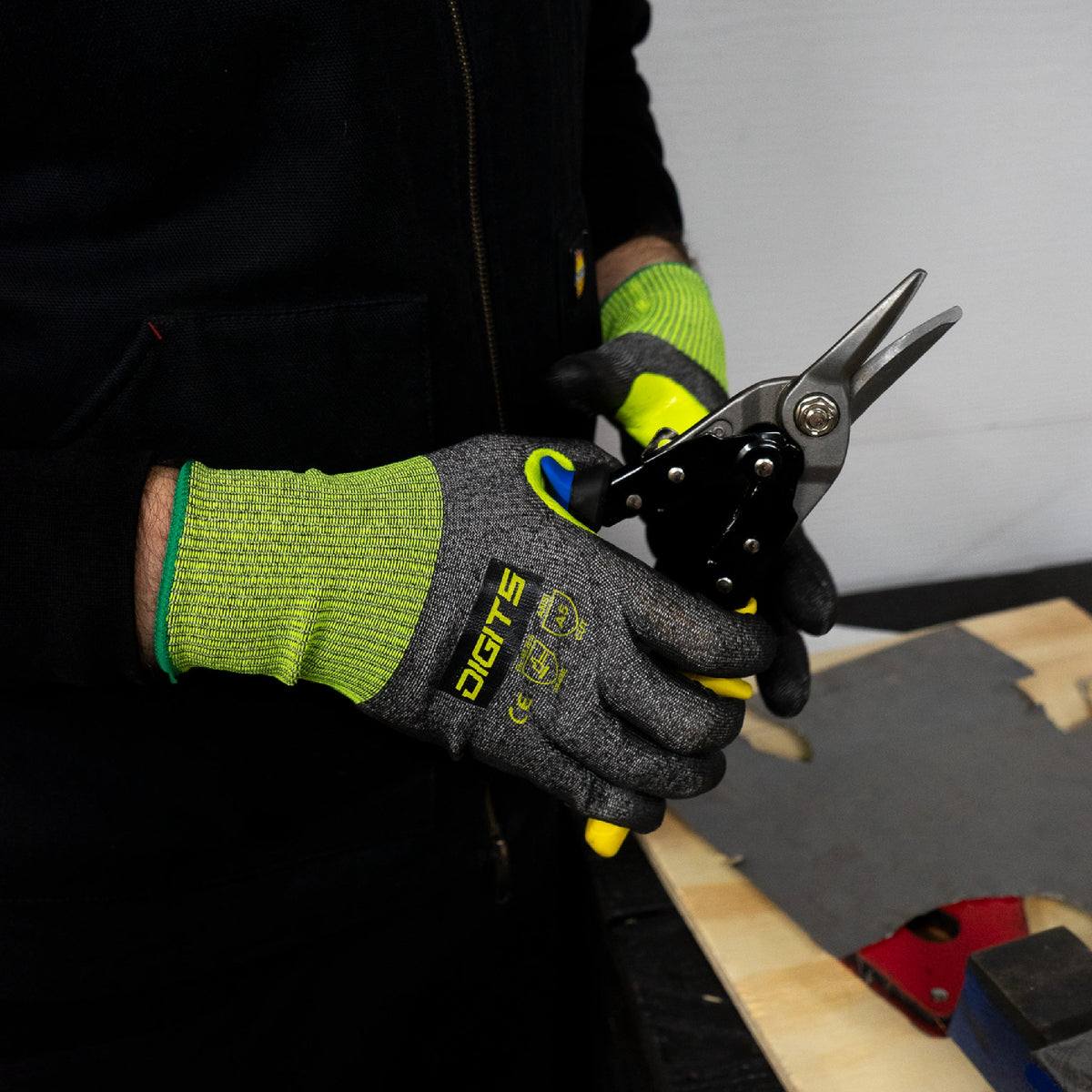
When you're working with sharp sheet metal, handling metal components, or spending your days in a fabrication shop, your hands are constantly exposed to hazards. One wrong move around a sharp edge can turn an ordinary workday into a trip to urgent care.
That's why choosing the right work gloves matters.
But with so many different cut-resistant gloves on the market, how do you know which level of protection you actually need?
You've probably seen terms like ANSI A3, ANSI A5, or ANSI A7 printed on work gloves. These aren't just marketing labels. They're standardized classifications that help workers understand and compare a glove's resistance to cuts.
At Digits Workwear, we developed our Steelguard PRO gloves with ANSI A5 cut resistance because we believe workers should be able to protect their hands without sacrificing the flexibility and control they need to get the job done.
Let's break down what ANSI A5 means, how these ratings work, and when cut-resistant gloves are worth having in your toolbox.
What Does ANSI A5 Cut Resistance Mean?
ANSI A5 cut resistance means that a glove material has been tested to withstand a cutting force between 2,200 and 2,999 grams under standardized laboratory conditions.
This classification is part of the ANSI/ISEA 105 hand-protection standard, which is widely used in the United States to evaluate different protective properties of work gloves.
The ANSI cut-resistance scale ranges from A1 through A9.
A1 represents the lowest cut-resistance category on the scale, while A9 represents the highest.
ANSI A5 falls within the middle-to-higher portion of that range, offering considerably more cut resistance than basic gloves designed for light handling tasks.
For people working around sharp materials, A5 gloves can offer a useful balance of protection and dexterity.
However, it's important to understand one thing: cut-resistant does not mean cut-proof.
An ANSI A5 rating measures resistance under a controlled test. It doesn't guarantee protection against every sharp object, and the rating shouldn't be interpreted as the amount of weight a glove can safely withstand in real-world use.
Understanding ANSI Cut Resistance Ratings: A1 Through A9
The ANSI/ISEA cut-resistance system divides gloves into nine protection categories based on standardized blade-cut testing.
Here's a simplified breakdown.
| ANSI cut level | Cutting force | General classification |
|---|---|---|
| A1 | 200–499 grams | Light cut resistance |
| A2 | 500–999 grams | Low cut resistance |
| A3 | 1,000–1,499 grams | Light-to-medium cut resistance |
| A4 | 1,500–2,199 grams | Medium cut resistance |
| A5 | 2,200–2,999 grams | Medium-high cut resistance |
| A6 | 3,000–3,999 grams | High cut resistance |
| A7 | 4,000–4,999 grams | Very high cut resistance |
| A8 | 5,000–5,999 grams | Extremely high cut resistance |
| A9 | 6,000+ grams | Highest cut-resistance classification |
The higher the rating, the greater the material's measured resistance to the standardized cutting test.
However, higher isn't automatically better for every job.
A glove rated A9 may provide substantially greater cut resistance than an A5 glove, but the appropriate choice also depends on fit, coating, flexibility, grip, and other hazards.
A worker handling small metal components may have different needs than someone processing heavy scrap metal with extremely sharp edges.
The goal isn't necessarily to purchase the highest-rated glove available. It's to select a glove with protection appropriate to the job.
For more information, see the ANSI/ISEA 105-2024 hand protection classification guide.
How Are ANSI Cut-Resistant Gloves Tested?
ANSI cut-resistance ratings are determined through standardized laboratory testing.
During testing, a blade is drawn across a material sample under carefully controlled conditions. The testing process evaluates the force needed to cut through the material.
Results are used to determine which ANSI cut-resistance category applies.
This approach provides a more consistent way to compare glove materials than relying on vague claims like "heavy-duty" or "extra protection."
But laboratory testing has limits.
Real-world hazards can include sharp corners, concentrated pressure, repeated contact, unpredictable movements, and damaged materials.
That's why ANSI ratings should be used as one part of a broader safety assessment rather than a guarantee against injury.
What Jobs Are ANSI A5 Cut Resistant Gloves Good For?
ANSI A5 cut-resistant gloves are worth considering for work involving meaningful cut hazards where workers also need hand mobility and control.
1. Sheet Metal Handling
Sheet metal can create particularly challenging hand hazards.
Freshly cut pieces, unfinished edges, and sharp corners can slice through ordinary fabric gloves.
Whether you're moving sheet metal into position, installing panels, or handling fabricated components, selecting a glove with an appropriate cut rating is important.
An A5-rated glove can be an option for some sheet-metal handling tasks, depending on the specific hazards.
2. Metal Fabrication
Fabricators regularly handle sharp stock, metal components, and materials with unfinished edges.
In many of these tasks, workers also need the dexterity to handle fasteners, position parts, and operate hand tools.
A flexible, cut-resistant glove can be useful when handling materials away from hazardous moving machinery.
3. HVAC Installation
Ductwork often contains sharp edges and corners.
HVAC installers may need to handle sheet metal while making measurements, positioning sections, and installing fasteners.
For these tasks, a glove that combines cut resistance with finger mobility can help maintain control.
4. Automotive and Mechanical Work
Automotive work often involves working around stamped metal components, brackets, sharp edges, and confined areas.
A5 cut-resistant gloves may be appropriate for certain tasks where sharp metal contact is a concern.
5. Construction and Demolition
Construction sites can contain exposed metal strapping, sharp-edged building materials, and discarded metal components.
Depending on the task and level of exposure, cut-resistant gloves may provide additional protection compared with general-purpose work gloves.
6. Industrial Material Handling
Certain warehouse and manufacturing operations involve handling metal parts, strapping, shelving, or components with sharp edges.
In these environments, matching the glove's cut rating to the identified hazard is especially important.
Why Cut Resistance Shouldn't Come at the Expense of Dexterity
A glove can have impressive laboratory ratings and still be frustrating to use if it's too bulky for your work.
Think about how many times during the day you need to pick up a small screw, thread a nut, position a bracket, or grab a tool.
If your gloves constantly get in the way, working efficiently becomes more difficult.
That's why dexterity matters.
Dexterity refers to your ability to move your fingers and manipulate objects while wearing gloves.
The materials and construction of a glove play a major role in how much dexterity it offers.
Thicker or stiffer designs may be suitable for some hazards, but workers doing precision-oriented jobs often prefer gloves that maintain a closer fit and better tactile control.
Modern cut-resistant fibers make it possible to produce gloves that combine meaningful cut resistance with relatively lightweight construction.
What Materials Make Cut-Resistant Gloves Work?
Cut-resistant gloves can be constructed from a variety of specialized materials.
Common options include high-performance polyethylene (HPPE), aramid fibers, steel fibers, and engineered blends.
High-Performance Polyethylene (HPPE)
HPPE is a high-strength synthetic fiber commonly used in cut-resistant gloves.
It helps provide mechanical strength and cut resistance while allowing manufacturers to produce relatively lightweight knitted liners.
Steel Fiber Reinforcement
Certain gloves incorporate fine steel fibers into the knitted material.
These fibers contribute to the liner's mechanical resistance to cutting.
The result can be a stronger protective fabric without requiring the entire glove to be constructed from heavy material.
Aramid Fibers
Aramid fibers are another common material used in protective gloves.
Depending on their construction, aramid gloves can provide cut resistance and other protective properties.
However, different products have different tested ratings, and the material alone doesn't determine a glove's complete performance.
Protective Palm Coatings
Many cut-resistant gloves also include a coated palm.
Polyurethane, nitrile, and other coatings can improve grip and surface-wear resistance.
The coating is important, but it shouldn't be confused with the glove's tested cut rating.
The liner and complete material construction play significant roles in cut resistance.
Introducing the Digits Workwear Steelguard PRO
When we developed the Digits Workwear Steelguard PRO, the goal was straightforward.
We wanted a cut-resistant glove that provided substantial protection without feeling like you were wearing something bulky every time you reached for a tool.
The Steelguard PRO combines ANSI A5 cut resistance with several practical features designed for precision-oriented work.
ANSI A5 Cut Resistance
Steelguard PRO is rated ANSI A5 for cut resistance.
Its protective liner incorporates HPPE and steel fiber, making it a practical option to evaluate for work involving sharp materials.
Ultra-Thin 18-Gauge Construction
Steelguard PRO uses an 18-gauge seamless knitted liner.
The fine-gauge construction is designed to provide a close, lightweight fit that moves with your hand.
Polyurethane-Coated Palm
A black PU-coated palm provides additional grip and abrasion resistance while retaining flexibility.
This helps maintain control when handling tools and materials.
Reinforced Thumb Area
The area between the thumb and index finger experiences significant wear during everyday handling.
Steelguard PRO includes reinforcement in this high-wear zone to help improve durability.
Touchscreen Compatibility
Checking measurements, responding to messages, or looking at digital work orders shouldn't always require taking your gloves off.
Steelguard PRO features touchscreen-compatible fingertips for use with compatible devices.
Breathable Design
The knitted back helps improve airflow, while the snug cuff helps limit the entry of dust and debris.
Together, these features make Steelguard PRO a practical option for workers who need a comfortable, flexible glove for extended tasks.
Shop Steelguard PRO ANSI A5 Cut Resistant Work Gloves
ANSI A5 vs. A3: What's the Difference?
One of the most common comparisons when shopping for cut-resistant work gloves is ANSI A3 versus ANSI A5.
The primary difference is the amount of cutting force the material resists under standardized testing.
ANSI A3 covers 1,000 to 1,499 grams.
ANSI A5 covers 2,200 to 2,999 grams.
That means A5 materials demonstrate greater resistance in the prescribed test.
A3 gloves may be appropriate for certain lower-cut-risk tasks, while A5 gloves may be better suited to situations involving more substantial sharp-edge exposure.
The correct selection still depends on the job and the hazards involved.
ANSI A5 vs. A7: Do You Need a Higher Cut Rating?
ANSI A7 gloves provide a higher level of tested cut resistance than ANSI A5 gloves.
A7 covers 4,000 to 4,999 grams, compared with 2,200 to 2,999 grams for A5.
Some operations involving extremely sharp or heavy metal materials may require a higher cut-resistance category.
But there are other considerations.
The weight, flexibility, fit, and grip of different gloves can vary significantly.
Rather than choosing solely by cut level, workers and employers should evaluate the actual cutting hazards and the tasks being performed.
What ANSI A5 Gloves Do Not Protect Against
Cut resistance is only one category of hand protection.
An A5 rating does not establish that a glove is suitable for:
-
Welding, sparks, or molten metal
-
High-temperature materials
-
Electrical hazards
-
Chemical exposure
-
Hypodermic needles or pointed-object punctures
-
Crushing or impact injuries
-
Entanglement hazards involving rotating equipment
For example, a glove designed for handling sheet metal should not automatically be used while welding.
Likewise, gloves can become entangled in drill presses, lathes, and other rotating machinery. Follow equipment-specific safety instructions and never wear gloves where they create an entanglement hazard.
A properly selected glove should address the actual risks of the task, not just one favorable rating.
How to Choose the Right Size Cut-Resistant Gloves
Fit plays an important role in how a glove performs.
A glove that's too large can make it harder to handle small objects and may create excess material around moving equipment.
A glove that's too tight may restrict movement or become uncomfortable over time.
When selecting your size:
-
Measure your hand according to the manufacturer's sizing guide.
-
Choose a fit that allows natural finger movement.
-
Check that the fingertips aren't excessively loose.
-
Make sure the glove doesn't restrict your ability to grip tools.
-
Replace gloves that have become stretched, damaged, or excessively worn.
Steelguard PRO is available in Small, Medium, Large, XL, and XXL, with 3-pack and 10-pack purchasing options.
How to Care for ANSI A5 Cut Resistant Gloves
Even high-performance work gloves need regular inspection and care.
For Steelguard PRO, Digits Workwear recommends hand washing in cold water, avoiding bleach, and hanging the gloves to dry.
Do not iron or expose them to excessive heat.
Before each use, inspect the fabric and palm coating.
Pay particular attention to the fingertips, reinforced thumb area, and any locations that have experienced contact with sharp edges.
If the glove has holes, significant fiber damage, or visible deterioration that could compromise protection, replace it.
Frequently Asked Questions About ANSI A5 Gloves
Are ANSI A5 gloves cut-proof?
No. ANSI A5 gloves are cut-resistant, not cut-proof. The rating indicates performance under standardized testing conditions and does not guarantee protection against every sharp object or cutting situation.
Is ANSI A5 enough for sheet metal?
ANSI A5 gloves may be appropriate for some sheet-metal tasks, depending on the material, edge condition, handling method, and overall hazard assessment. Extremely sharp materials or higher-risk operations may require additional protection.
Is A5 better than A4?
A5 provides a higher level of cut resistance under ANSI/ISEA testing. A4 covers 1,500–2,199 grams, while A5 covers 2,200–2,999 grams. However, choosing the right glove also requires evaluating the fit and other protective characteristics.
Are ANSI A5 gloves good for mechanics?
They can be suitable for automotive and mechanical tasks involving sharp edges or metal components, provided there are no conflicting hazards such as rotating machinery, heat, or chemical exposure.
Can you wash cut-resistant gloves?
Some cut-resistant gloves can be washed according to manufacturer instructions. Steelguard PRO should be hand washed in cold water and hung to dry. Never assume washing will restore the protection of a damaged glove.
What makes Steelguard PRO cut-resistant?
Steelguard PRO combines an 18-gauge seamless liner with HPPE and steel fiber construction, resulting in an ANSI A5 cut-resistance classification.
Protect Your Hands Without Sacrificing Control
Choosing cut-resistant work gloves shouldn't be complicated.
Start by understanding the materials you handle, the hazards involved, and the level of protection the job requires.
ANSI cut ratings give you a reliable way to compare tested material performance, while glove construction, fit, and coating determine how the gloves feel during actual work.
At Digits Workwear, we built Steelguard PRO for workers who want a dependable balance of ANSI A5 cut resistance, grip, and dexterity.
Whether you're handling sheet metal, fabricating parts, or completing other precision-oriented jobs involving sharp materials, selecting the right hand protection is one decision worth getting right.
PROTECT YOUR DIGITS.
Dipped Work Gloves: The Ultimate Guide to Grip, Cut Resistance & Durability
Best Work Gloves for Metal Fabrication and Sheet Metal: What to Look For